Jigsaw
Jigsaw is a cooperative learning strategy that asks groups of students to become “experts” on different aspects of a topic and then share what they learn with their classmates. Just as in a jigsaw puzzle, each piece — each student's part — is essential for the completion and full understanding of the final product.

Step 1: Expert Groups Investigate
When using the Jigsaw activity, the first step is to get into small groups. You will be given an investigation or exploration task. In this small group, you'll need to work together to do something: a probe, an explication, a close read, a summary, etc.
Step 2: Teaching Groups Share and sometimes investigate
Once the original groups have completed their task, the groups are reconfigured so that one of you from each of the initial groups forms a new group. Once in the new groups, you'll take turns sharing what they uncovered in the first step of the jigsaw activity. Sometimes, after you share, you'll be asked to identify the through-line. In other words: why these four tasks?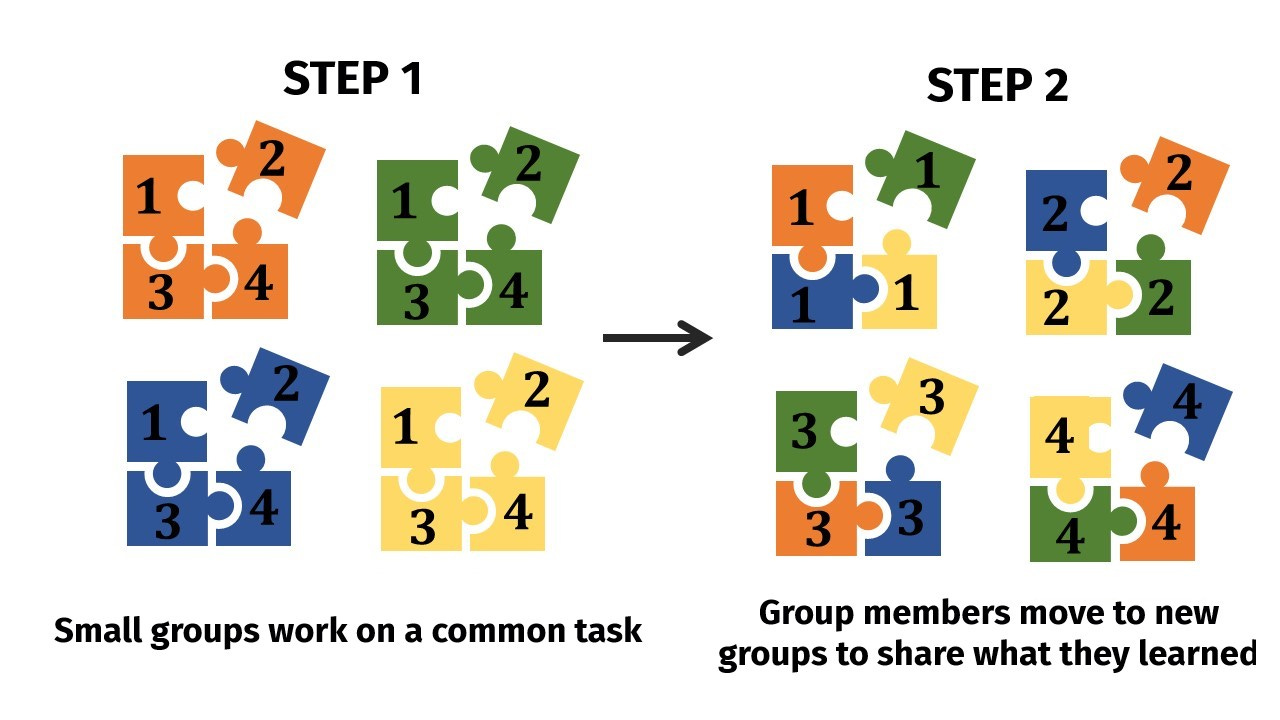
If each student's part is essential, then each student is essential.
Step 1: Expert Groups Investigate
When using the Jigsaw activity, the first step is to get into small groups. You will be given an investigation or exploration task. In this small group, you'll need to work together to do something: a probe, an explication, a close read, a summary, etc.
Step 2: Teaching Groups Share and sometimes investigate
Once the original groups have completed their task, the groups are reconfigured so that one of you from each of the initial groups forms a new group. Once in the new groups, you'll take turns sharing what they uncovered in the first step of the jigsaw activity. Sometimes, after you share, you'll be asked to identify the through-line. In other words: why these four tasks?